© 2026 nimisham.in
At 10 years, he learnt the art himself and now, 22-year-old Om Chitara a ninth-generation artist is among those keeping the dwindling art of Mata ni Pachhedi alive.
At 10 years, he learnt the art himself and now, 22-year-old Om Chitara – a ninth-generation artist – is among those keeping the dwindling art of Mata ni Pachhedi alive.
Literally translating to ‘Behind the Mother Goddess’, Mata ni Pachhedi is a ritual textile painted with Goddess Durga as the central theme. Mastered by the Chitaras, a community of Devipujaks (earlier called Vaghri), it started as a form of protest over 300 years ago, when the community was not allowed inside certain temples. The community largely resides in Ahmedabad and around it.
Om says the tradition took shape across different periods for different reasons: during times of conflict and temple destruction, the cloth offered a portable form of worship; later, caste barriers made it an alternative for communities denied entry into temples.
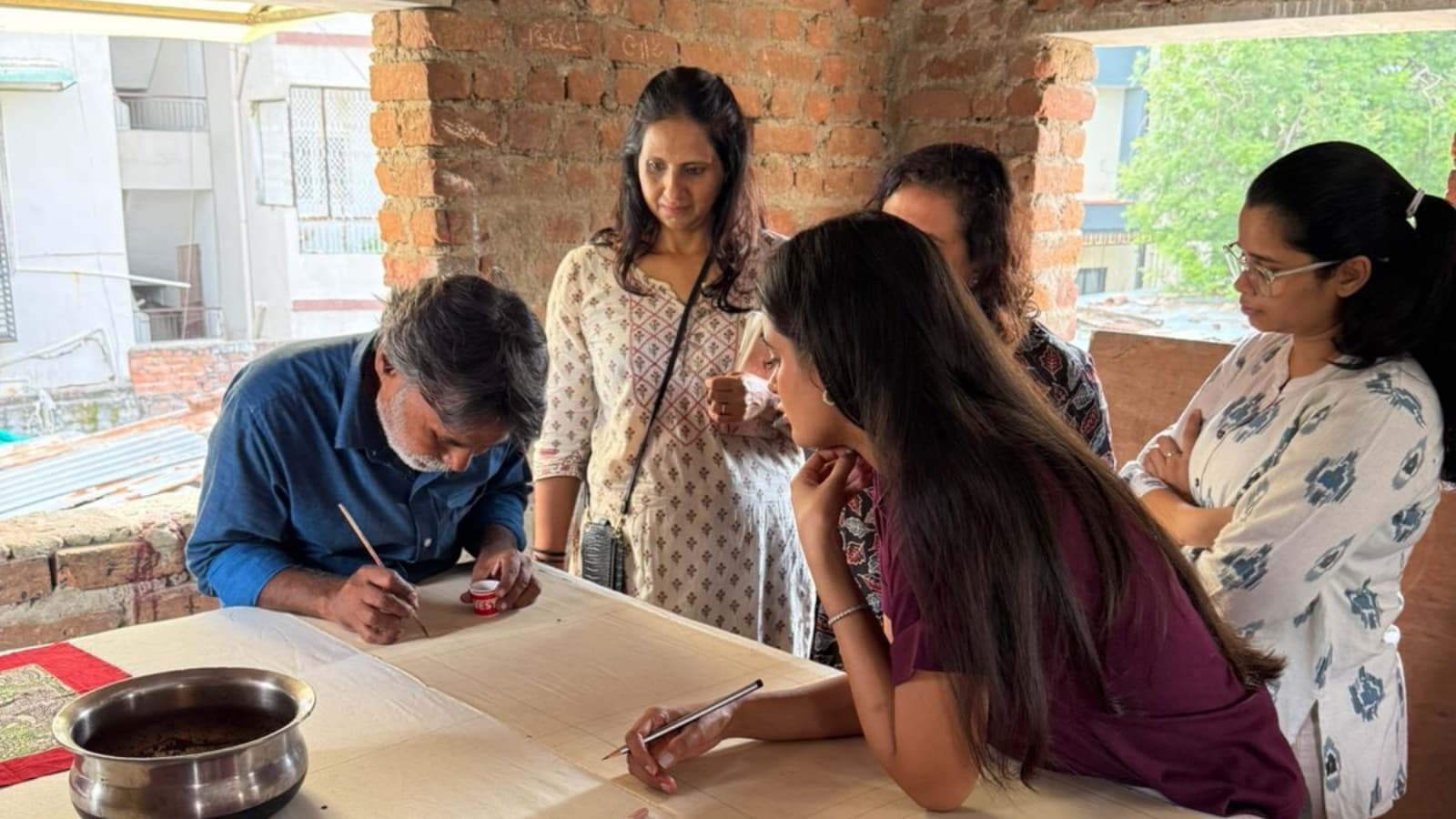
The studio has unbleached fabric laid out to dry, earthen pots containing organic dyes made of indigo, henna and wild turmeric. Using specialised bamboo ‘kalam pens’ they draw on the fabric much like the kalamkari form of art used in clothing textile.
“Traditionally, our art relied purely on deep red derived from alum and tamarind seed paste; Black extracted from iron rust fermented with jaggery and water. We expanded our palette to use natural ingredients,” says Om.
Om describes his training as having begun from paper before moving on to cloth. His father, Kiranbhai Chitara, won the national award in 2005. In 2023, the Mata ni Pachhedi got a Geographical Indication tag and in 2025 another artist Bhanubhai Chitara got a Padma Shri.
Creating a piece measuring 2×2 feet takes up to two-and-a-half months. “The most time-consuming phase is the freehand drawing and line detailing using sharp bamboo sticks, followed by multiple rounds of mordanting, boiling in madder root and sundrying along the riverbanks,” says Om.
The final stage is boiling. Dhavdi (flame of forest) flowers and alizarin are used to fix the colours onto the fabric. The process leaves little room for error. “If a problem crops up during washing, the whole painting gets ruined; if colour turns out bad, the painting gets ruined; if the cloth isn’t treated properly, the colour will spread,” Om says.
He is eager to keep the art alive. “If we don’t make efforts, who will do so? This art will vanish completely,” he says.
Although it is part of their livelihood, there is no fixed monthly production as each size of artwork decides its timeline. During the Covid-19 pandemic, when tourists stopped coming to the workshop, the family relied partly on online support.
“The way the art form is represented can determine whether audiences see it simply as an attractive object or understand the knowledge system behind it”, she says. She was particularly struck by the younger audiences who did not necessarily identify strongly with its religious associations but connected with the animals, fish, trees and other elements of nature represented in the artwork.
The many forms of goddesses are known by their vehicles: Khodiyar Mata is associated with a crocodile, Meladi Mata with a goat, while Shetrunji Maa, the Goddess worshipped by Om’s community, is depicted with an elephant. The colours, too, carry meaning. Traditionally, Om says, Mata Ni Pachhedi was dominated by three colours: red, black and white. Red represented the Goddess, black was associated with protection from evil powers, and white represented good. Other colours were introduced later, as the craft evolved.
Om says people from villages still come to buy Chandarvo and Mata Ni Pachedi for worship, while hand-drawn pieces are also bought as wall art and gifts. The difference between the two forms is significant. A block-printed piece can take around 15 days. A similarly sized hand-drawn piece can take a year and a half or more. Om says block-printed works sell for around Rs 40,000–₹50,000, while large hand-drawn pieces can sell for around Rs 4–4.5 lakh, depending on the artwork. The family has also adapted the imagery. Contemporary elements such as the Tree of Life have been incorporated into some works, responding to changing preferences while retaining the core visual language of the craft. Artificial intelligence or machines may be able to recreate a design, he says, but they cannot easily replicate the knowledge behind the process. “This isn’t just drawing. There is an entire process behind it,” he says.
The family’s most immediate challenge, however, is the limitations of space. A large commission such as a seven-metre saree can occupy an entire space, leaving little room for other artists. When individual pieces take months or even a year to complete, production is inevitably limited. During winter, Om says, around 20–25 tourists can visit the workshop in a day to see the process, learn about the craft and buy the artwork.
(Kalindi Jha is an intern at The Indian Express, Ahmedabad)